Along with the fast innovation of technology, AI technology has progressed a lot further than people have expected it to progress. The basic ideas started in the 1950, but it actually became very popular in late 2010, and I believe it’s still rapidly increasing, especially after the introduction of ChatGPT, Grammarly, and other AI media that people could easily access.
SOUNDRAW
I have tried ChatGPT before to get some ideas on my research paper topics before. I had rough ideas, but I couldn’t connect them together and I remember ChatGPT being a big help in putting my clustered ideas together.
So I wanted to try something new, and I got interested if there were generative sound AI’s. So I explored a few areas and found a generative AI called Soundraw.
It first made me choose the length, tempo and genre of the music I was looking for.
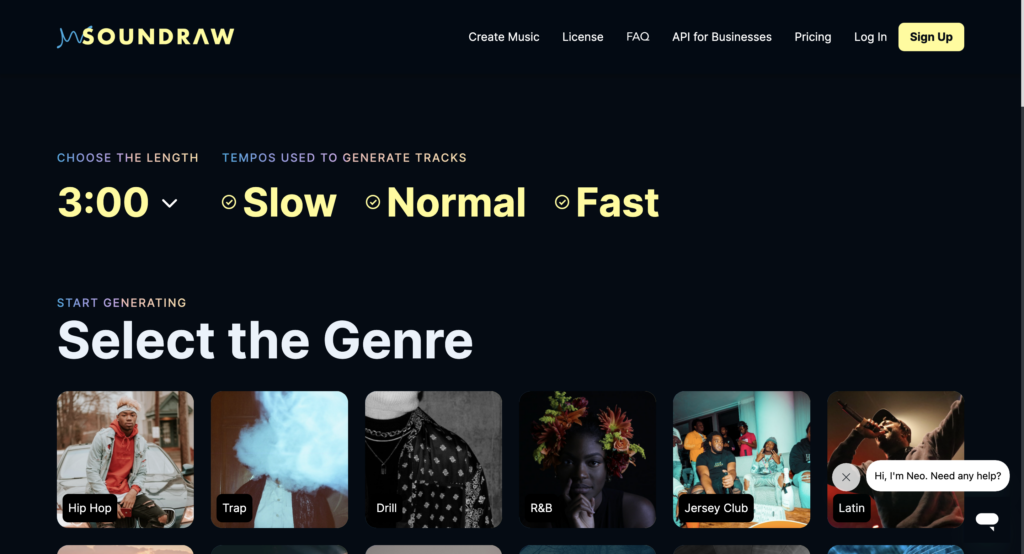
I think it was trying to get a rough idea of what I wanted, I went with 3:00 minute and deselected slow, and selected a pop genre.
After, it led me straight into a page where it displayed multiple music right away.
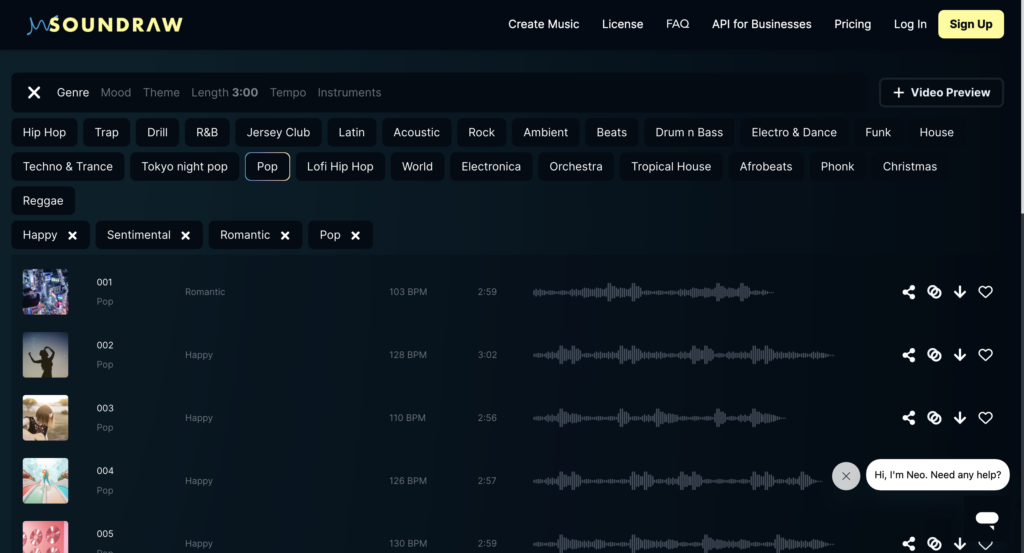
I could edit the length, tempo, and genre I selected in the beginning, and I could add even more descriptive ideas to it, such as selecting lovely, happy mood, and even themes. I would try listening to it, edit the volume mixer, and skip to parts I wanted to skip to, add to favourites, share, block, download, and else.
I was obviously restricted from doing some activities, which is enabled after paying for membership, and downloading the generated audio was one of them. However, while I was exploring what I can do for free, I noticed that in the membership, it allows you to keep the license forever, as well as distribution to popular music streaming platforms such as Spotify and Apple music. And the “owner” gets to take all recording royalties.
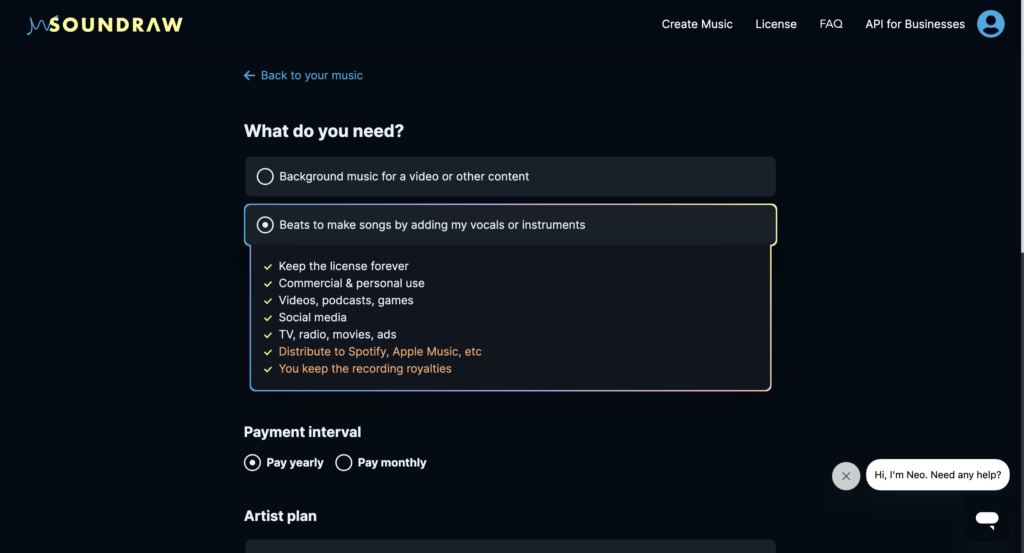
This is where it made me question the ethical considerations on the generative AI.
Screenshots from: Soundraw, OpenAI, 2 Apr. 2024, https://soundraw.io/create_music
Ethical Considerations of Generative AI
There are many ethical considerations of generative AI. Data usage, privacy, biased results, decision making, and others. In this post, I want to talk about ethical considerations in art.
Unlike the text-to-speech generative AI, other art-type generative AI such as AI generated pictures, videos, and sounds could have copyright considerations. The generative AI is known to learn from the input data – which often includes human work. And in an area where copyright is very important, such as artwork, music, and such, AI can generate things so easily very fast based on things it learned from – a human’s work without consent. Consuming on generative AI that learned from other people’s work without the artists’ consent is now creating art that at faster speed, as the user wanted without question, and even for free. And for some generative AI, like Soundraw I have showed above, they even grant the license to the buyer and gives them the right to distribute on public platforms, with the royalties.
An AI that learned from media without the artists consent, creating similar artwork, and granting the license to the user who only input the command line. If this is not resolved, the art industry will soon run out of real-people business. I don’t think this should be allowed. Not only it steals the data from the creditted artist, it also makes the people in the industry to have less jobs because some customers would not commision them anymore, which directly connects to their social determinants of health. Same goes for sound generative AI too. It will learn from many songs that people created, and produce sound in less than a minute, and if you only pay $30, you can take its full license.
Is it really right for the buyer to take the credit? When the AI learned based off many real-people’s work?
The SECTIONS from my old “Learning Resource” blog:
Students: The audience of this blog post is for people who are interested in hand-knitting basics. I introduced how to make a foundation chain (aka starting chain), how to create foundation loops, and how to add rows on top of them, as well as how to finish them. There are many patterns in knitting and my video would be great for the starters before they take on the complicated patterns.
Ease of use: As my video was designed for the beginners, it will not require any skills or training. It will only need the material which people would already have by the time they would search up the video or consider buying.
Cost: The only cost of my video would be the yarn they will be using for their own project. Because the video does not really produce one set material for a certain project, the cost really depends on how big of a project the audience wants to do. If they would like to make a simple lap blanket, just one big yarn would be fine which would usually cost about $10-$20, but if they want to make a full sized blanket, they would cost about 12 yarns or more which would easily go over $100.
Teaching: I feel like what I have showed was a good content. However, it could definitely get way better. Because I didn’t have a place I can comfortably record, I was stuck on my desk with a desk camera. If I was able to move the angles up closer easily, with smoother lighting, it would have helped the audience so much better, especially because if you’re only just starting to learn how to knit, it can be really confusing since there are many, many, many hooks.
Interaction: Since my content was more like a “watch and follow” learning, I wouldn’t say it was a passive-learning interaction. Rather, I would say it was an active interaction for the audience and the material of my media, as it is most likely to make them craft it on-hands.
Organizational issues: There would be no maintenance my content will require as long as YouTube allows me to keep it posted. It does not use any form of software other than its published platform, does not involve any method that could cause me an onganizational issues.
Networking: I’m not sure if I can broaden the network using the medium I created as it is very specific to knitting. However, it will be a lot easier if the course setting was in a small group of people, such as 2 to 20 people in one long table, so the instructor can walk around and help people as it involves complicated handworks. For people who were not able to make it, they can watch the video and learn, but if they ever have questions, they might struggle until they need to watch other videos or meet the instructor in-person again.
Security and privacy: The video can be watched alone, and could be shared online. Because it is posted based off the university-approved website, it would be confident to say it is secured and safe to use.
Leave a Reply
You must be logged in to post a comment.